





If you have a kid who likes to tell stories, writes little scenes in the Notes app, keeps a half-finished “chapter one” in a folder somewhere, or narrates their entire life like it is a movie, pay attention. That instinct is not “extra.”, it’s a skill. And in a world where so much content is generated, summarized, shortened, and optimized, the ability to think clearly and create something original is becoming more valuable, as opposed to less.
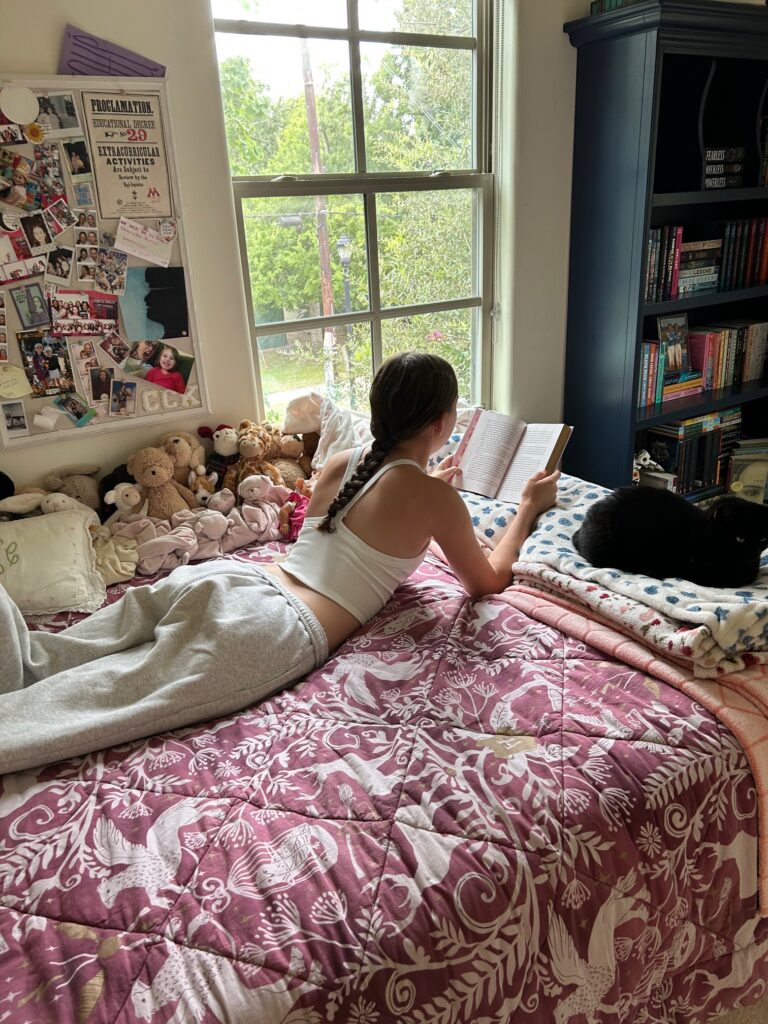 We’ve fostered reading (and by extension creative expression) with our daughters since they were babies. Starting with reading board books each night, we graduated to developing short stories on the way to school (always with a cliff hanger as we approached drop off). Now 15 and 13, they have each taken their own paths in writing, reading, and creativity.
Our oldest daughter embraced reading at a very early age. In 2nd grade, she was introduced to the world of Harry Potter. That first sentence lit the fuse on a consumption of that series so deeply that she reread the series 27 times by the time she was in 5th grade. She even got to a point where could finish a book in a little over a day, start the next one, finish the series in a week, then start back over. It was awesome.
We had little restriction over the subject matter of books she could read, although we had to step in when she stumbled upon 50 Shades of Gray. However, we let her find her own way through YA, biographies, some classics, and of course fantasy. When it became time to give her a cell phone, we were concerned that it would replace the Kindle that had become an extension of her hand for years. Thankfully, her reading (and passion for that experience) never waned.
Eventually, that love of reading became a love of writing and a new world opened up for her.
The Benefits of Creative Writing
Creative writing is one of the simplest ways to nurture that skill of written expression, because writing forces your child to do the work that no algorithm can do for them: notice, feel, choose, decide, and make meaning. They can seek connections between their thoughts and stumble upon paths they never knew they could take.
As parents, we can become too goal and outcome-focused. I have to constantly holster my feeling that any action they take needs S.M.A.R.T. rigor and successful completion. However, that’s the easiest way to stamp out any passion for a kid’s creative expression because for them, it’s that free play on the page that is their objective. Yet that freedom can develop valuable skills as they grow into adults.
A Stronger Voice, not Just Better Sentences
When kids write creatively (or even read actively outside of school-assigned books), they practice making choices. What matters in this scene. What a character would do or should do differently. What details to include. What the ending should feel like. The number of times our daughter wrote scathing reviews on Goodreads hinted at her own decisions for those characters that were misaligned with her vision of their outcome. That is their voice, but it’s also the building blocks of confidence.
A child who learns to say something clearly on a page is a child who is more likely to say something clearly in real life.
Emotional Processing Without a Lecture
Some kids are natural talkers, yet some are not. Writing (and reading) gives them a private, low-pressure place to process what they are thinking. Fiction lets them explore feelings or subject matter indirectly, without the high stakes we as parents assign to many of their choices. Poetry gives them permission to be intense in an unstructured and accessible way. Personal essays help them shape experiences into something they can put into words and eventually draw upon in their lives as they grow.
Even the simple act of journaling at night can develop the muscle memory for transitioning thoughts into sentences and better process their emotions in a productive way.
Better Thinking
Writing is thinking. If kids can organize a story, they can organize an argument. If they can build a character, they can build empathy. If they can revise a paragraph, they can revise a plan. Creativity is not just a soft skill. It is training for decision-making. It’s no surprise that our oldest daughter has transferred that love of reading into debate in high school.
It’s not just the pen to paper that helps connect those dots. It’s the pen to paper, to reflection, to rewriting, to changing, to finishing that thought in a way that captures the emotional narrative playing in their minds.
I want to take a moment here to acknowledge that much of the above can be developed through other forms of creative expression, not just writing. Our youngest daughter expresses herself through crafting, drawing, collaging, and using her hands (along with copious amounts of hot glue), to satisfy that creative itch. Any time our kids can spend a few minutes creating something in an unstructured environment without a time limit or rules is so valuable.
Raising Readers and Writers Right Now: The Hard Part
 We are parenting (and our kids are aging) in an era of constant input. Kids are swimming in content, but much of it is designed to addict versus inspire. They can scroll for an hour and still feel bored (or anxious), because the brain gets used to novelty without effort. Ask them what they just spent 15 minutes watching and the recall will be limited, if not vaguely memorable. It’s this mental junk-food snacking that slowly adjusts the settings in their brains to expect little to no value from their content inputs.
Creative writing, however, can flip that script. It turns kids from passive consumers into active creators. While AI can be an incredible part of the creative process, the downside is that it’s too often used as a shortcut that can thwart the wrong turns and dead ends critical to developing creative thinking. The creative process is clunky, non-linear, and is oftentimes about the journey, not the destination. If AI is used in that process, it shouldn’t replace that learning process.
How to Encourage Creative Writing in Your Kids
If creative writing is something your child is interested in, or begins to show promise, here are some ways you can help foster that skill without it feeling like homework.
Start small and remove pressure
Going back to the earlier point of assigning “adult” goal orientation to a child’s discovery process, let them define what “creative writing” looks like and how that will translate to the page. If you’re more curious about what they’ve come up with as opposed to the steps they took to get there (or timeframe), they will be more likely to continue the practice because it’s now on their terms.
Give Them Constraints to Help in Their Process
Whether it’s a time constraint, creative suggestion (“Write a story that takes place in one room”) or any condition that might challenge their thinking, the resulting problem solving and effort will feel like a game and unlock those inner creative juices.
Preach the Revision Process
I’ve heard the writing process best described as ironing a shirt. It takes multiple passes to smooth out the wrinkles and end up with your finished piece. Kids of any generation can lack the patience and dedication to multiple revisions of their work. That’s when it turns into homework. However, if you can work with them to reframe revisions as a new story or even different take on their original idea, it can help them build confidence in the ideas they want to keep, perspective on the things that can change, and an understanding that creativity is a process, not a onetime effort.
Use AI the right way
AI can be useful as a brainstorming partner, but it should not replace their voice. Let AI help generate prompts or outlines, then require that the actual writing is theirs. That mirrors the direction of the Houston Youth Writing Competition, which allows AI only for outlining or suggesting a prompt and does not allow AI-generated text.
Houston Youth Writing Competition
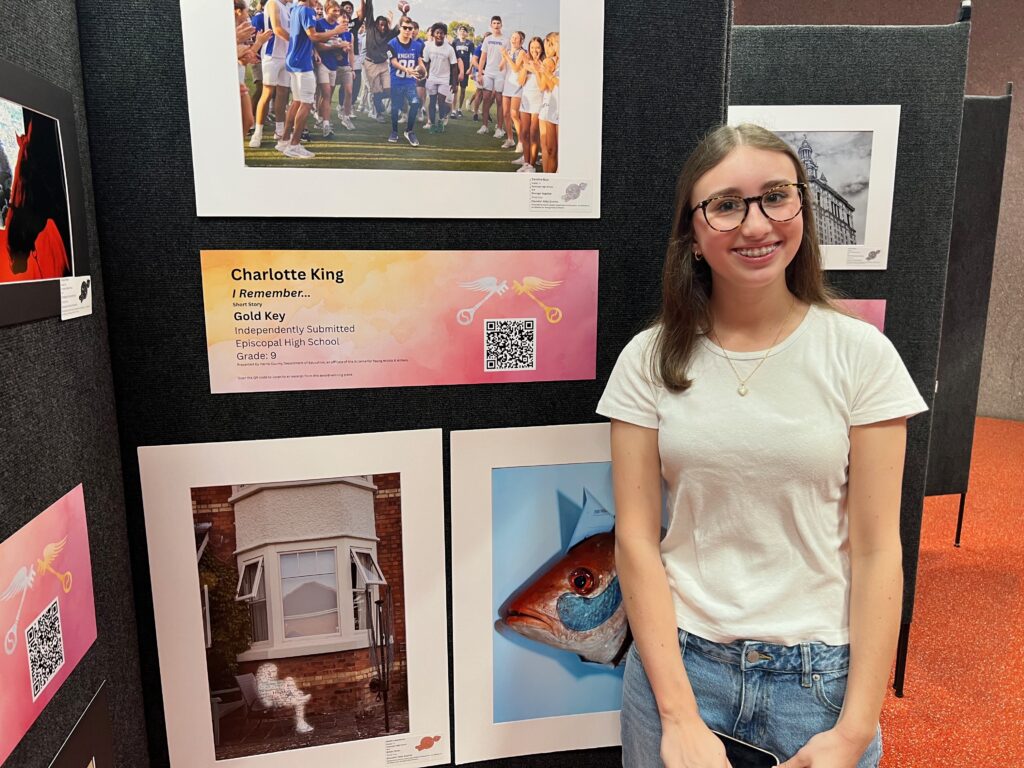
This is personal for me, because my daughter created the Houston Youth Writing Competition, and I want Houston families to know it exists. The competition is open to students in grades 7–12 in the Greater Houston area, including public, private, charter, and homeschool students.
Key details:
- Submission window: February 1 to May 1, 2026 (11:59 PM CST)
- Categories:
- Poetry (any form, max 100 lines)
- Short Fiction (max 3,000 words)
- Creative Nonfiction (personal essays and nonfiction, max 3,000 words)
- Students can submit up to two entries, each submitted separately
- Judging is blind and scored on originality, personal voice, technical skill, and clarity and coherence
- Winners announced: June 20, 2026
There is also a clear stance on AI that my daughter put in place for this competition: AI can be used only to create an outline or suggest a prompt, but entries cannot include AI-generated text, and screening software will be used. Every teen has a story in them, this is a chance to take that first step.
I don’t think every child needs to become a novelist. I don’t think every kid who writes poems at 1 a.m. needs to be told they are “the next” anything. But I do think every child benefits from having a craft that builds attention, imagination, and self-trust.
In a distracted world, the kids who can sit with an idea and shape it into something real will have an advantage. In a world full of generated text, the kids who can write like a human will stand out. And it starts the same way most good things start. One sentence. One paragraph. One story.