


Mark your calendars, Houston moms: Texas tax-free weekend runs Friday, Aug. 7 through midnight Sunday, Aug. 9, 2026. With most Houston-area districts heading back Aug. 12 and 13 {and a few brave souls starting as early as Aug. 5}, this is officially your last-chance, get-it-done weekend for back to school shopping in Houston.
Here’s the deal in one sentence: most clothing, footwear, school supplies, and backpacks priced under $100 per item are exempt from sales tax all weekend long, whether you shop in-store or online. Texas charges a 6.25% state sales tax and local jurisdictions can tack on up to 2% more, which is why most of the Houston area pays the full 8.25% combined rate. That’s what you’re skipping this weekend. Spend $300 on back-to-school basics and you’re keeping about $25, which, let’s be honest, is at least a school-year’s worth of “Mom, I need a dollar for the fundraiser.”
But the rules have some genuinely weird fine print and knowing it is the difference between a smooth checkout and an unpleasant surprise at the register. Consider this your cheat sheet.
 The Golden Rule: Under $100, Per Item
The $100 limit applies to each individual item, not your total. You can buy ten $80 pairs of jeans and every single pair is tax-free, even though you just spent $800 {no judgment, we’ve all seen how fast a middle schooler grows}. But one $105 backpack? Taxed on the full amount. There’s no partial exemption, so a $100 item is taxed and a $99.99 item is not. Retailers know this, which is why you’ll see a lot of $99.99 price tags this weekend.
What Counts
Clothing and shoes
Almost everything your kids actually wear qualifies: jeans, shirts, dresses, shorts, socks, underwear, pajamas, school uniforms, jackets, and, yes, cowboy boots {this is Texas, after all}. Everyday sneakers, tennis shoes, sandals, and running shoes without cleats all count. Swimsuits and workout clothes qualify too, because you can wear them for more than just sports. Diapers, both baby and adult, are exempt, along with baby clothes and bibs. Even Halloween-adjacent items like kids’ novelty costumes make the list, so if you have an early planner in your house, go for it.
Backpacks
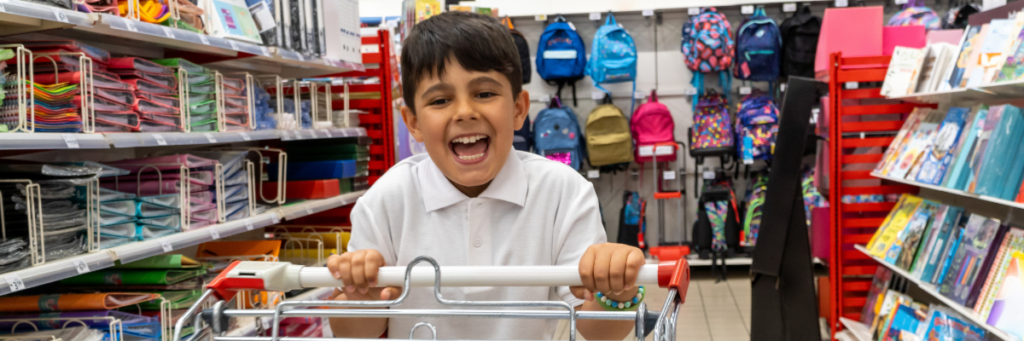
Student backpacks under $100 qualify, including rolling backpacks and messenger bags. You can buy up to 10 at a time without any paperwork, so grab one for every kid plus a backup.
School supplies
This one is a specific, defined list, and only items on that list count. The good news is it covers the essentials: notebooks, binders, folders, pencils, pens, crayons, markers {dry erase included}, highlighters, glue sticks, scissors, rulers, calculators, index cards, composition books, poster board, construction paper, pencil boxes, and lunch boxes. Yes, lunch boxes and calculators are on the list, which surprises a lot of people. Pre-assembled school supply kits qualify too, as long as the exempt items in the kit are worth more than the taxable ones.
 What Doesn’t Count
This is where families get tripped up every year, so read this part twice:
- Computers, tablets, and software. Texas does not exempt electronics, period. {Some other states do, which is where the confusion comes from.} If a new laptop is on your list, tax-free weekend won’t help you there.
- Anything $100 or more. No exceptions, no partial credit.
- Athletic and protective gear. Cleats, football pads, helmets, shin guards, and ballet or dance shoes are all taxable because they’re designed for one specific activity. The quirks here are truly something: a baseball cap is tax-free but baseball cleats are not, and a baseball jersey counts but baseball pants don’t.
- Accessories. Jewelry, purses, wallets, watches, hair bows, headbands, and umbrellas are all taxable. Funny enough, a belt with the buckle attached is exempt, but buy the buckle by itself and you’ll pay tax.
- Bags that aren’t student backpacks. Framed backpacks, luggage, duffle bags, gym bags, computer bags, and briefcases don’t qualify.
- Headphones and earbuds. They’re not on the school supply list, even though they’re on half the actual school supply lists your teachers send home. Same goes for tissues, hand sanitizer, and disinfecting wipes.
- Rentals, alterations, and clothing subscription boxes. Also sewing supplies like fabric, thread, and buttons.
 The Online Shopping Fine Print

You absolutely can shop tax-free from your couch, and we recommend it! The rule is that your payment has to go through during the holiday window, even if the items don’t ship until later. Order qualifying school supplies at 5pm Sunday and they don’t arrive until the following week? Still tax-free. But here’s the gotcha: if your card gets declined at 11pm Sunday and you don’t resubmit until Monday morning, that purchase is now taxable. Don’t wait until the literal last minute.
One more sneaky detail: shipping charges count toward the $100 limit. A $90 pair of jeans with an $11 delivery fee becomes a $101 item and now the whole thing is taxed. {Heads up if you’ve seen articles from other states saying shipping doesn’t count. That may be true where they live, but in Texas it does.} Watch your cart totals on anything hovering near the cutoff or look for free-shipping thresholds.
Tips and Tricks to Squeeze Out Every Dollar
Shop your house first. Before you buy a single glue stick, raid last year’s supplies. Half-used notebooks, perfectly good scissors, and that bin of unopened pencils from the 2024 Target run all still work. Make a list of what you actually need and set a budget, because “everything is tax-free” is exactly the mindset that leads to spending $200 you didn’t plan on to save $16 you did.
Bring the kids into the budget. Financial experts love this weekend as a real-life money lesson. Let your kids see the budget, know the limit, and help make the trade-offs {the $95 sneakers OR the character backpack, kiddo, not both}. They learn something, and you get a built-in accountability partner when you’re tempted by the clearance endcap.
Scout the retailer lists before you go. Big stores like Walmart and Target publish their own browsable lists of items that qualify for the tax holiday. Ten minutes of scrolling before you leave the house saves you from playing “Is this exempt?” in aisle 12 with three kids in the cart.
Stack the savings. Sales tax savings apply on top of whatever promotions retailers are already running, and stores lean hard into back-to-school deals this exact weekend. A clearance item that’s also tax-free is the double-coupon energy we’re chasing.
Don’t sleep on resale. Secondhand and resale shops count too, as long as the item is under $100. Kids’ resale stores around Houston are a goldmine for barely-worn uniform pieces and name brands your tween will actually agree to wear, and the tax exemption applies there just like anywhere else.
Use layaway strategically. Putting a qualifying item on layaway during the weekend, or making the final payment on something already on layaway, locks in the exemption. Special orders work the same way: pay for that back-ordered $80 shirt during the holiday and it’s tax-free even if you pick it up weeks later.
Teachers, this is your weekend too. The exemption applies to everyone, not just parents, so classroom supplies bought with your personal card qualify. {If you’re buying under a school or business account, you’ll need an exemption certificate, so personal purchases are the simpler route.}
Stick to retailers you know online. Consumer protection folks warn that scammy pop-up ads spike during big shopping weekends. If a deal from an account you’ve never heard of seems too good to be true, it is.
Check your receipt. If a store accidentally charges you tax on a qualifying item, you’re entitled to a refund. Ask the seller directly, and if they won’t handle it, they can give you a form to file the refund claim with the Comptroller’s office yourself.
 The Bottom Line
Three days, one simple rule {under $100 per item}, and a little strategy can take real pressure off the most expensive shopping weekend of a parent’s year. Make your list, shop early in the weekend before the good sizes disappear, and keep those receipts.
For the complete official item lists, visit the Texas Comptroller’s Sales Tax Holiday page.